



MOTORCYCLE
Motorcycle Tire Manual
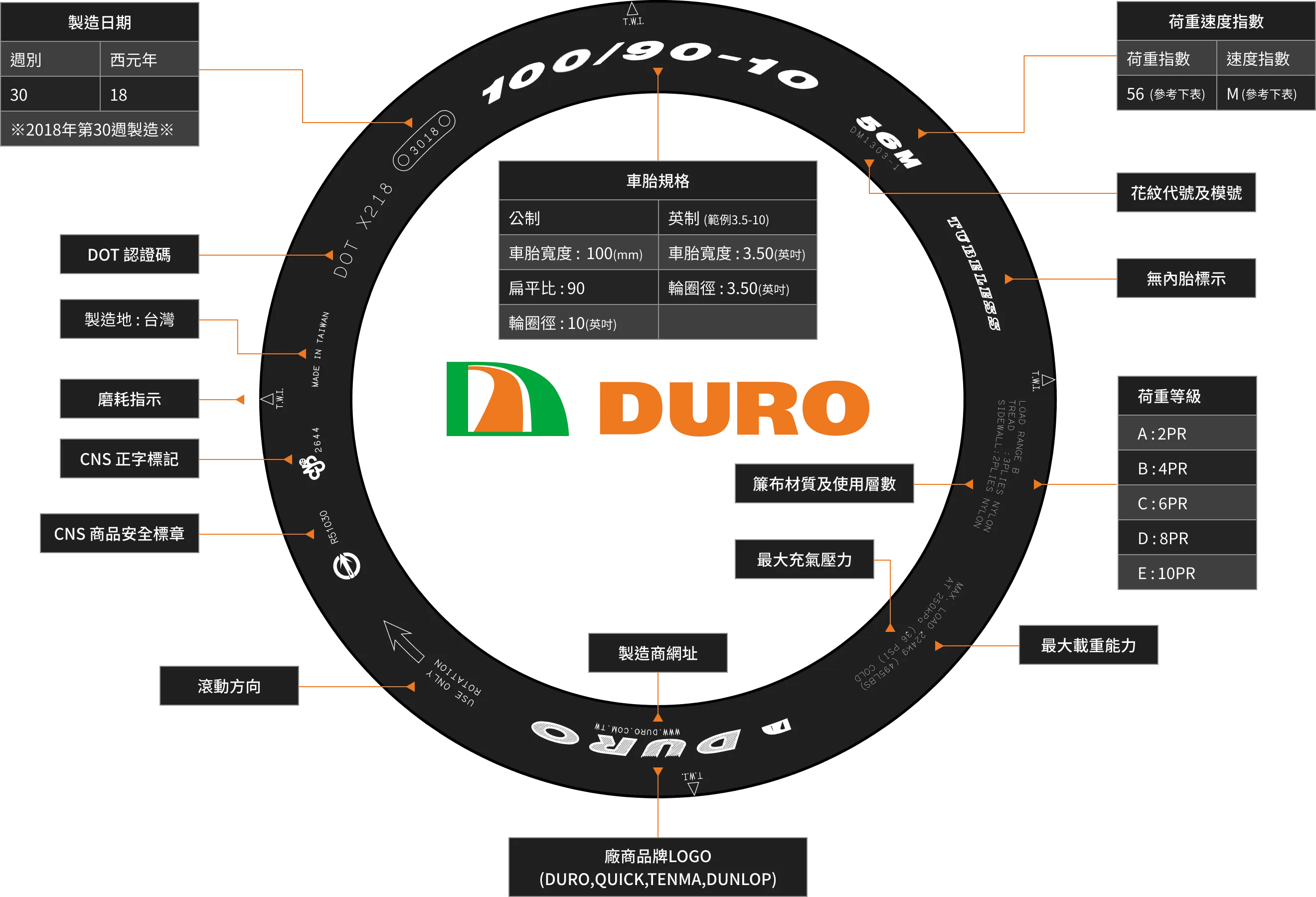
TIRE MARKINGS EXPLAINED
Physical Marking:In compliance with internationally accepted English marking standards.
Ball
Tire Installation and Service Life
It is recommended that the useful life of the tire be up to ten years from the date of manufacture,
which may be shortened depending on the conditions of use.
Ball
| Load Index (kg) | |||
|---|---|---|---|
| rating = kg | rating = kg | rating = kg | rating = kg |
| 40 = 140 | 48 = 180 | 56 = 224 | 64 = 280 |
| 42 = 150 | 50 = 190 | 58 = 236 | 66 = 300 |
| 44 = 160 | 52 = 200 | 60 = 250 | 68 = 315 |
| 46 = 170 | 54 = 212 | 62 = 265 | 70 = 335 |
| Speed Rating (km / h) | |||
|---|---|---|---|
| rating = km/h | rating = km/h | rating = km/h | rating = km/h |
| B = 50 | F = 80 | L = 120 | Q = 160 |
| C = 60 | G = 90 | M = 130 | R = 70 |
| D = 65 | J = 100 | N = 140 | |
| E = 70 | K = 110 | P = 150 | |
| Material | Steel、Rubber、Carbon、Nylon、Fabric |
Tire Uses and Precautions
- Tires are essential components of machines or vehicles, providing forward, steering, and braking functions while reducing vibrations from uneven road surfaces.
- For optimal performance and safety, always use tires from the same manufacturer, with matching specifications and tread patterns, suitable for the vehicle's conditions of use.
- When mounting tires, follow the standards set for the specific rims to ensure proper fit and alignment.
- Maintain the recommended tire pressure as specified by the vehicle manufacturer, considering the load being carried.
- When changing tires, check the valves for leaks and ensure the valve cap is securely tightened to prevent air loss.
- Regularly inspect tire pressure, tread, and sidewalls for damage before each ride. If any abnormalities are detected, visit a nearby automotive workshop for inspection and maintenance.
- After mounting the wheels, carefully inspect the tire and rim for proper fit and perform a water test to check for air leaks.
- Tires that have been in use for over 5 years should undergo a thorough inspection to determine if they are safe to continue using.

※Evaluation by professional staff: repair or replace※
Storage Considerations: Avoid the following situations in the storage area
- Avoid storing in areas directly exposed to sunlight and rainwater infiltration to prevent rapid aging of tires/tubes.
- Avoid storing in high-temperature areas near heat sources, sparks, or open flames to prevent rapid aging of tires/tubes and to prevent them from becoming flammable materials in case of fire.
- Avoid contamination with oils and chemicals to prevent deterioration of tires/tubes.
Usage Limits: It is recommended to immediately replace the tires/tubes in the following situations
- When the remaining tread depth is less than 1mm and there are three or more wear indicators around the circumference of the tire (indicated by ▲), indicating that the remaining tread depth is less than 1mm. The tire should be replaced immediately when the wear indicator aligns with the tire surface.
- When there are deformations or bulges in the tread or sides of the tire.
- When there are external damage and a professional determines that it cannot be repaired.
- It is suggested that the lifespan of tires be up to ten years from the date of manufacture. ※The lifespan of tires may be shortened based on actual usage conditions.

※Tread Wear Indicator (T.W.I.)※